The Dolce Soul of Basil

Standard

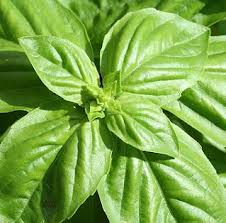
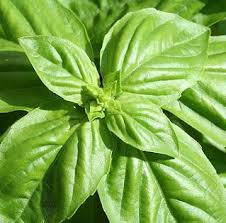
The other day, I had an especially strong need for some peace after an “interesting” day and knew right where to go: the garden.  The basil pots, to be precise.  And so I plucked and snipped the leaves and stems, immersing myself fully into a feast for the senses:  the vibrant smell, the radiant shades of green, the delicate beauty of the central leaves unfurling from those below, like a fountain. 

Even the nibbled (albeit discarded) leaves were somewhat appealing: a reminder of the abundance of life within the garden.  And all the while, I was anticipating its miraculous metamorphosis into pesto – and the fulfillment that comes with an act as primal and pure as planting and cultivating one’s own food, even if that food is a few leaves or sprigs. 
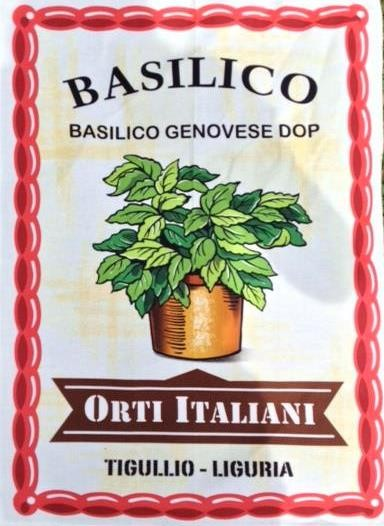
And oh what a plant it is.  Basil (a.k.a. ocimum basilicum) is a colorful character in the herb family.  Known as the “king of herbs” – from the ancient Greek word basilikon (kingly/royal) – it has an illustrious history.  From embalmer of the dead in ancient Egypt, to a traditional sign of engagement in Romania, it is also associated with the basilisk dragon.  In Italy, basil signifies love, yet in ancient Greece and Rome – and for the Victorians – basil meant hate.  Nicholas Culpeper explains in The English Physitian (1652) that, were a person to take even one whiff of basil, scorpions would grow in their brain.  Perhaps most memorable is basil’s reputation as a poison – one that would prompt “’venomous beasts’ to appear in horse-dung, and would not grow near rue – apparently a danger sign” (Oxford Plants 400).

Arguably the most artistic and vivid vision of basil belongs to Boccaccio, whose tale in the Decameron (1353), “Lisabetta and the Pot of Basil,” features the herb as a vessel of passionate love.  Boccaccio weaves together love and hatred, as Lisabetta’s malicious brothers murder her beloved, leaving Lisabetta only one thing to do: unearth her lover’s body, secretly plant his head in the bottom of a pot of basil, and water it with her tears.  Boccaccio inspired John Keats to write the narrative poem “Isabella, or the Pot of Basil” (1818), which, in turn, inspired John Everett Millais (1849), William Holman Hunt (1868), and John William Waterhouse (1907), among others, to paint their own versions of the story.  While the gruesome nature of the crime may have sparked such replication, I’d like to believe it was basil’s intoxicating nature that served as the muse. 
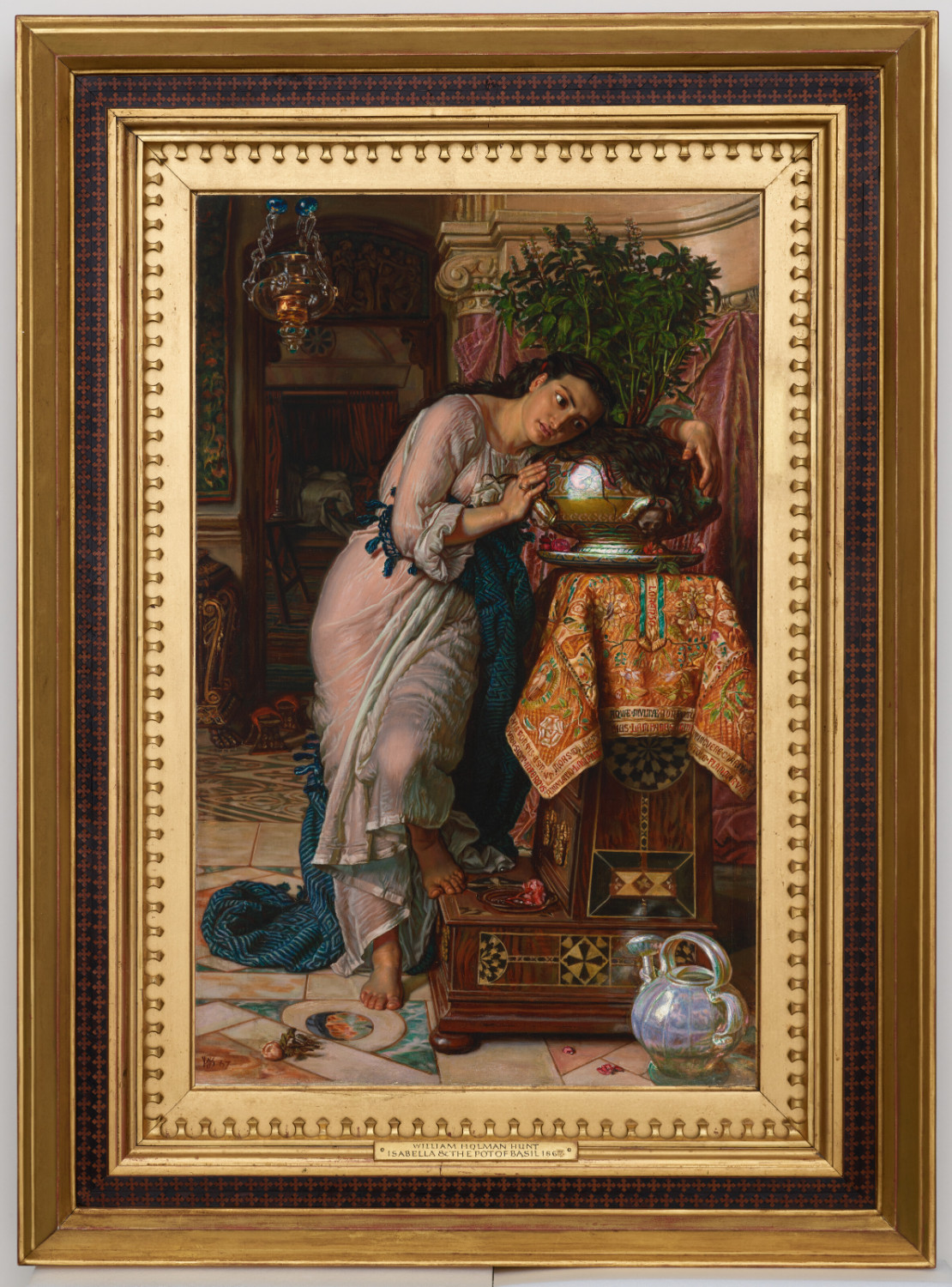
Isabella and the Pot of Basil, W. H. Hunt (San Francisco’s Legion of Honor Museum) 

Basil even signifies a sense of home: legend has it that Genovese sailors, yearning for and returning to their home port, could smell basil growing in window boxes from miles away.  I wonder if its aroma will remind my own children of home someday – of those days in our first house, blow-up baby pool and slip n’ slide in the backyard on a sweltering summer day, and those two packed wine-barrels overflowing with basil, its intense scent steaming off the hose-doused leaves. 
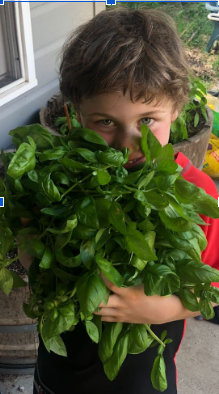
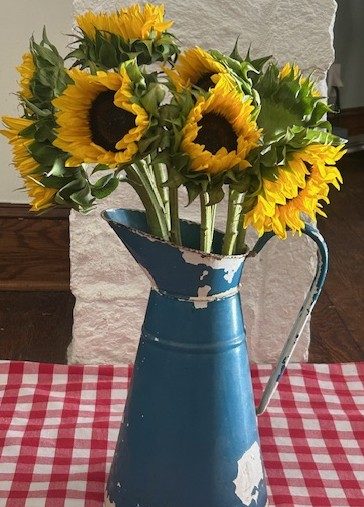
Fruits of the basil harvest: Joy in a bouquet of basil (2016)

Ok, time to snap back to the present! If you are not currently growing any basil, get yourself to your favorite nursery, Trader Joe’s, or even a home improvement store (less romantic than a nursery, but it does the trick).  You might not have enough to make pesto yet, but there’s always a caprese salad – or simply add one pungent leaf to a sandwich ~ or use a sprig  to garnish your next Negroni!  

And if you already grow it, immerse yourself.  When you pick a bouquet for your next batch of pesto (pesto post coming soon, btw), first plunge your head into the glorious greenery, close your eyes, inhale deeply, and let yourself waft in a restorative, aromatic bath of basil.
Little Italy in the Orto: The Italian Kitchen Garden Transplanted to America

Standard

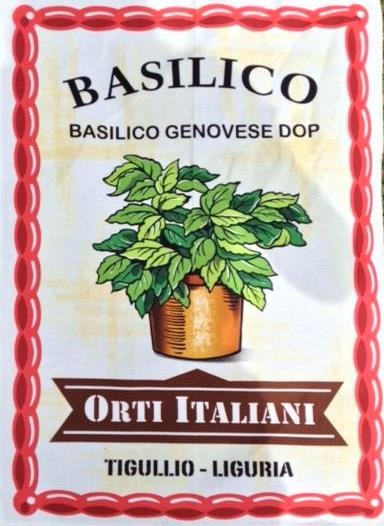
BASILICO TOWEL PIC FOR KGIOIA_crop

We stayed out of Umberto’s way – i.e. his vegetable garden – and he stayed away from our toys and swing set.  It was a mutual understanding.  We may have been mere preschoolers spending our afternoons at his home in the daycare his wife ran, but we knew never to pluck a strawberry or snap a zucchini vine for use as a jumprope.  It wasn’t clear what Umberto did when he wasn’t covered in dirt (or if he even spoke English), but we did know that this man lived for his garden and the food it produced.  The zucchini, lettuce, peppers, eggplant, and tomatoes were his babies to tend to, just as his wife Angie tended lovingly to us.

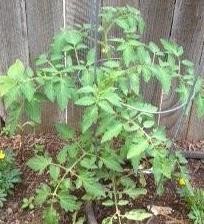
TOMATO_crop

Umberto and Angie had immigrated from northern Italy years earlier and had brought the established tradition of the orto — the Italian kitchen garden — with them to their new home, like many of the Italians who arrived in the late 19th and early 20th centuries had done before them.  Although growing one’s own vegetable garden has become more common today, the orto has long been a standard part of Italian life – for reasons both gustatory and economic.  Besides certainly serving as a haven from everyday worries, the Italian kitchen garden had a more concrete purpose for Umberto and his countrymen: it provided the simple ingredients for those fresh, vibrant recipes and flavors synonymous with Italian food.  By creating an orto in America, Umberto ensured he and his wife could continue to eat as they had when still in Italy.

But their garden was about more than satisfying their palates; it was a way for them to feel more at home in America.  To grow their own food and then taste those familiar flavors and meals helped them reconstruct the sense of home they had left behind.

When Italian immigrants poured into the US in the late 19th and early 20 centuries, they found themselves engulfed in an alien landscape, language, and world of flavors.  Eating Italian eventually would become possible, as immigrants opened Italian restaurants and planted ortos, and as Italian markets became thriving centers of the city, where those vegetables not grown in one’s orto could be purchased.

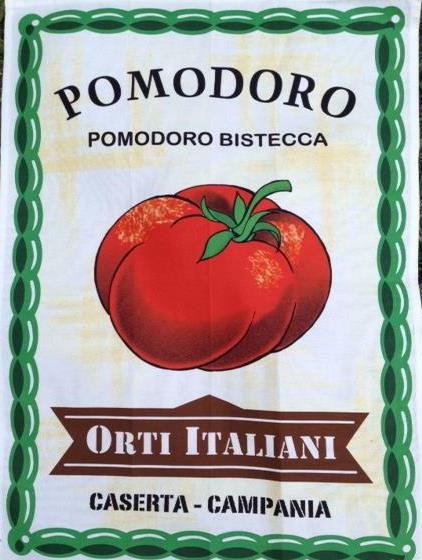
POMODORI TOWEL PIC FOR KGIOIA_crop

Some Italians took the orto a large step further and used their farming talents (many Italian immigrants had been farmers before they made their leap to the New World and brought seeds across the Atlantic) to become thriving participants in California’s agricultural industry.  The state’s mediterranean climate was just right for growing the Italian-farmed crops, which they would then sell in the larger produce markets.  According to Deanna Paoli Gumina in her The Italians of San Francisco, the Italians are credited with introducing San Franciscans to zucchini, broccoli, eggplant, Italian beans, bell peppers, parsley, garlic, rosemary, fennel, marjoram, oregano, and sweet basil.  With the Transcontinental Railroad transporting Californian produce across the country, the introduction of at least some of these vegetables and herbs must have included the populations of other cities as well. (Stay tuned for much more on this in a later post!)

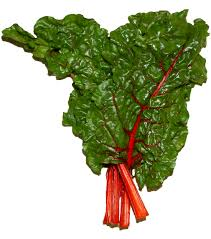
swiss chard

My father remembers his Italian mother tending to the family orto growing up in the 30s and 40s.  He recalls a plentiful yield of zucchini, lettuce, beans, and tomatoes, as the garden thrived under the care of her green thumb.  And years later, Grandpa Frank would spoil us with the treasures from his own prolific orto: he would bring armfuls of lettuce, beans, baby carrots, zucchini, parsley and Swiss chard nearly every time he saw us. He spent much time tending to his garden, while possibly also tending to the memory of his childhood orto. I wish I could ask him now if he planted and picked according to the moon’s cycle, as so many Italians still do.

My family has a little orto of our own, connecting us to Italy, our relatives, and our ancestors.  I see Grandpa Frank in the red-veined, dark green leaves of the Swiss chard my eldest son proudly planted in the winter.  I imagine my grandmother Nina tending to her family’s garden when I see our zucchini and tomatoes inching their way to fruition.  And I imagine her excitement at the prospect of transforming that ripe zucchini into a torta.  I am reminded of my father’s fig tree when I see ours, and I can taste my mother’s pesto when I pass by our 16 basil plants preparing themselves for my sons to pluck their leaves and help me whip them into pesto all summer long for their appreciative father.  Even baby loves to get in on the action by licking the spatula.

basil

There is nothing like growing your own food to transport and connect – connect to the earth, yes, but also to a land and lifestyle across an ocean; to connect to people with you, far from you, or those long gone — even those you never knew.   And growing your own orto — even if it is just a pot of basil or one small parsley plant — can give you the sense that you are linked with all of the above, as well as the Italian immigrant lifestyle of growing and eating the foods of their homeland.  They replanted their own Little Italy in America, in order to restore and retain the vibrant and familiar flavors of both food and home that they had left behind.

Try spinning those ingredients from your own orto into one of these Italian recipes (or just run to the store already and pretend you grew them):

ZUCCHINI TORTA ~ (adapted from my grandmother’s recipe):

Sauté 1 small onion and 2 cloves of garlic in 3 tablespoons olive oil.  Set aside until cool.

In a bowl, mix 1/4 cup parsley, 4 eggs, 1/2 cup grated parmesan, 1/2 tsp herbes de provence, 1/2 tsp oregano, 1/2 tsp salt, 1/2 cup breadcrumbs, 4 large grated zucchini, and the cooled garlic and onions.

Pour into a greased pan (I use 11 3/4 x 7 1/2, but something around that size will do. 8 x 8 will require more cooking time).

Bake for 45 minutes, or until firm to the touch and lightly browned on top.

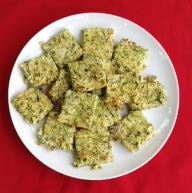
TORTA 1_crop

Zucchini Torta

PESTO ~ (inspired by a more elaborate recipe, without a couple of ingredients I don’t usually have lying around the house ~ but it still tastes amazing!)

Put in a blender or cuisinart (or if you are into being truly authentic, crush it all with your mortar and pestle) and whir together:

4 cups(-ish) basil leaves

2 cloves garlic

1/2 cup parsley (but if you don’t have any on hand, can be omitted)

1 tsp salt

1/2 cup olive oil

1/2 cup grated parmesan

~Enough pesto for a pound of pasta~


P.S. / FYI –  To grow your own veggies with a truly “authentic” Italian flavor, you can order up some seeds from the source at Seeds from Italy (www.growitalian.com).